

Turn websites into data for AI
Pick an Actor, give it a URL, get structured web data back - ready to plug into your agent, RAG pipeline, or AI app. No infrastructure to maintain.

POWERING THE WORLD'S TOP DATA-DRIVEN TEAMS












Generative AI is powered by web data
The web is the largest source of data ever created, and Apify makes it usable for AI. 30,000 Actors cover agents, RAG pipelines, and model training, so you can get structured web data without building the infrastructure to collect it.
Load vector databases
Crawl documentation, knowledge bases, and any other web source and return clean content ready to embed and query.
Train new models
Get text and images from across the web to generate the training datasets your new models need.
Fine-tune models
Use domain-specific web content to fine-tune your model with the OpenAI fine-tuning API or any framework that accepts structured data.

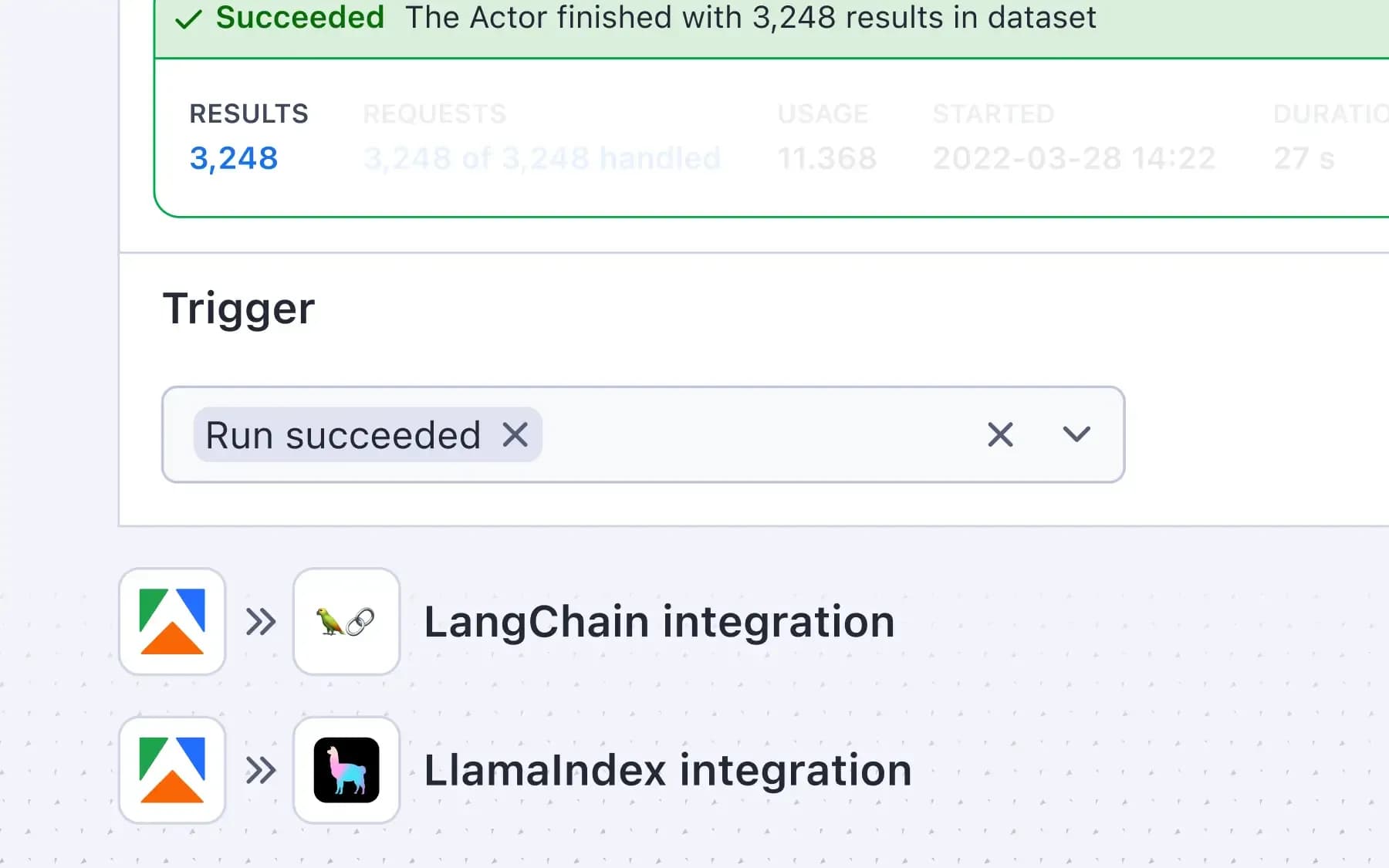
LangChain and LlamaIndex integration
Load scraped datasets directly into LangChain or LlamaIndex vector indexes. Build AI chatbots and other apps that query text data crawled from websites such as documentation, knowledge bases, blog posts, and other online sources.
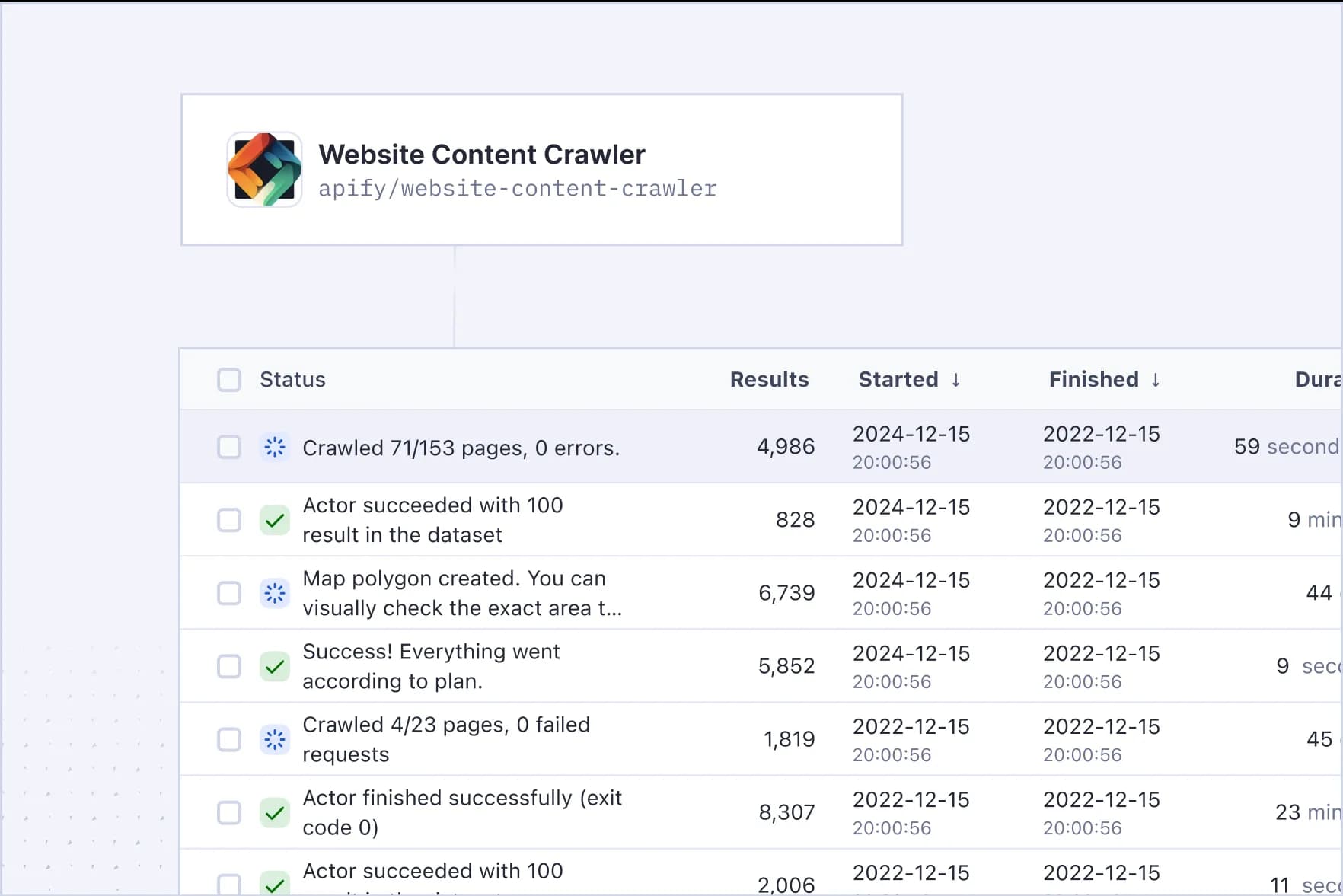
Ingest entire websites automatically...
Gather your customers' documentation, knowledge bases, help centers, forums, blog posts, PDFs, and other sources of information to train or prompt your LLMs. Integrate Apify into your product and let your customers upload their content in minutes.
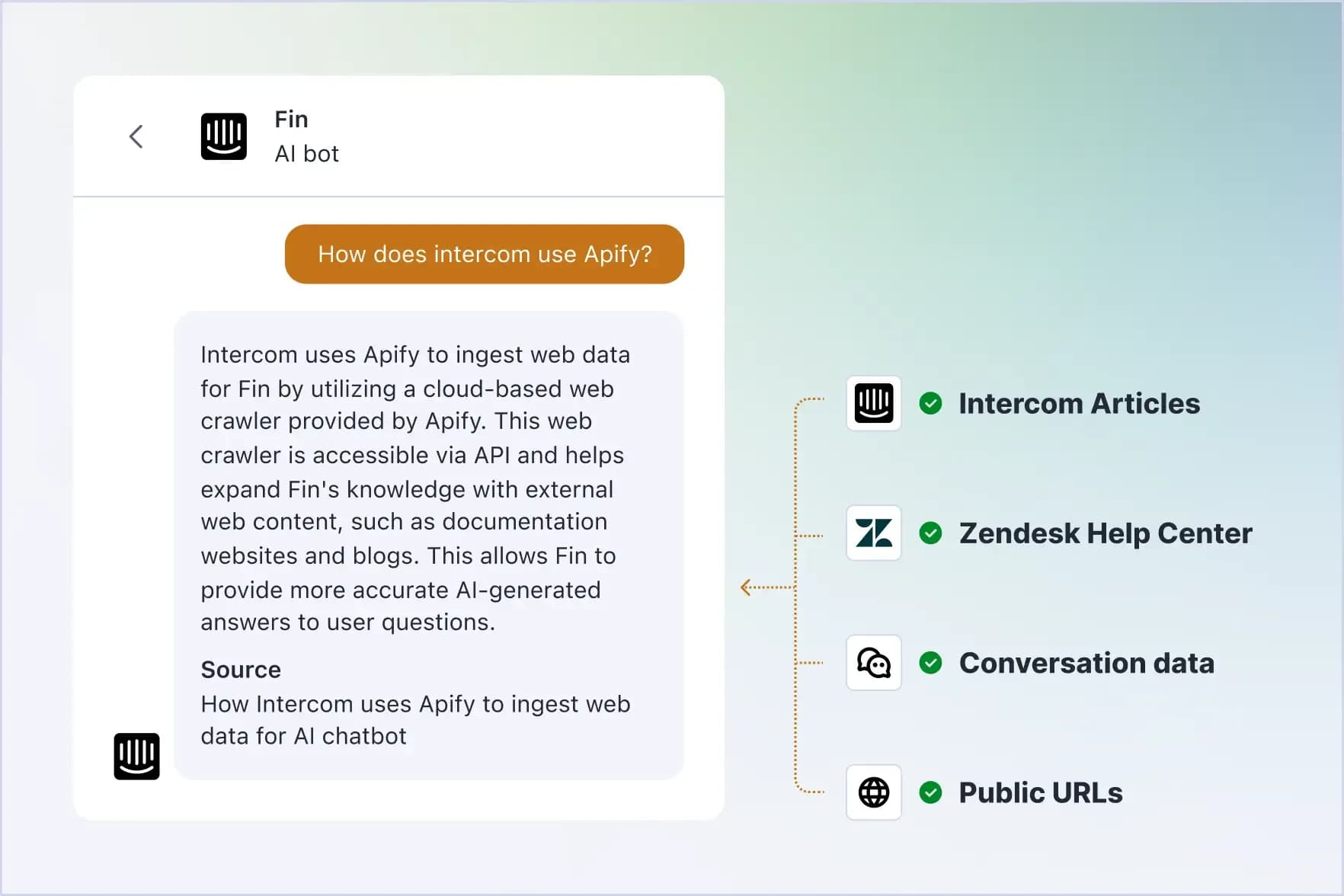
...and use that data to power chatbots
Customer service and support is one of the clearest places where AI is already delivering real value. Read about how Intercom built an AI chatbot that answers customer queries accurately by pulling live content from the web with Apify.
Connect agents with Apify tools through MCP
Apify's MCP Server lets agents find, run, and fetch data from the right tool automatically. Agents then operate independently, accessing live web data, reacting to real-world changes, and completing tasks without manual prompts.

Expand LLM capabilities with third-party data
Enrich your LLM with your own content and real-time web data so every response reflects what's actually true right now, not what the model learned months ago.
Monitor brand mentions, reviews, and sentiment
Pull real-time data from forums, review sites, and social media to give your chatbot genuine insight into brand sentiment, customer feedback, and emerging issues.
Improve the accuracy of chatbot responses
Make your chatbot more intelligent and accurate by integrating your own and external online sources. Impress users with precise, reliable, and personal interactions.
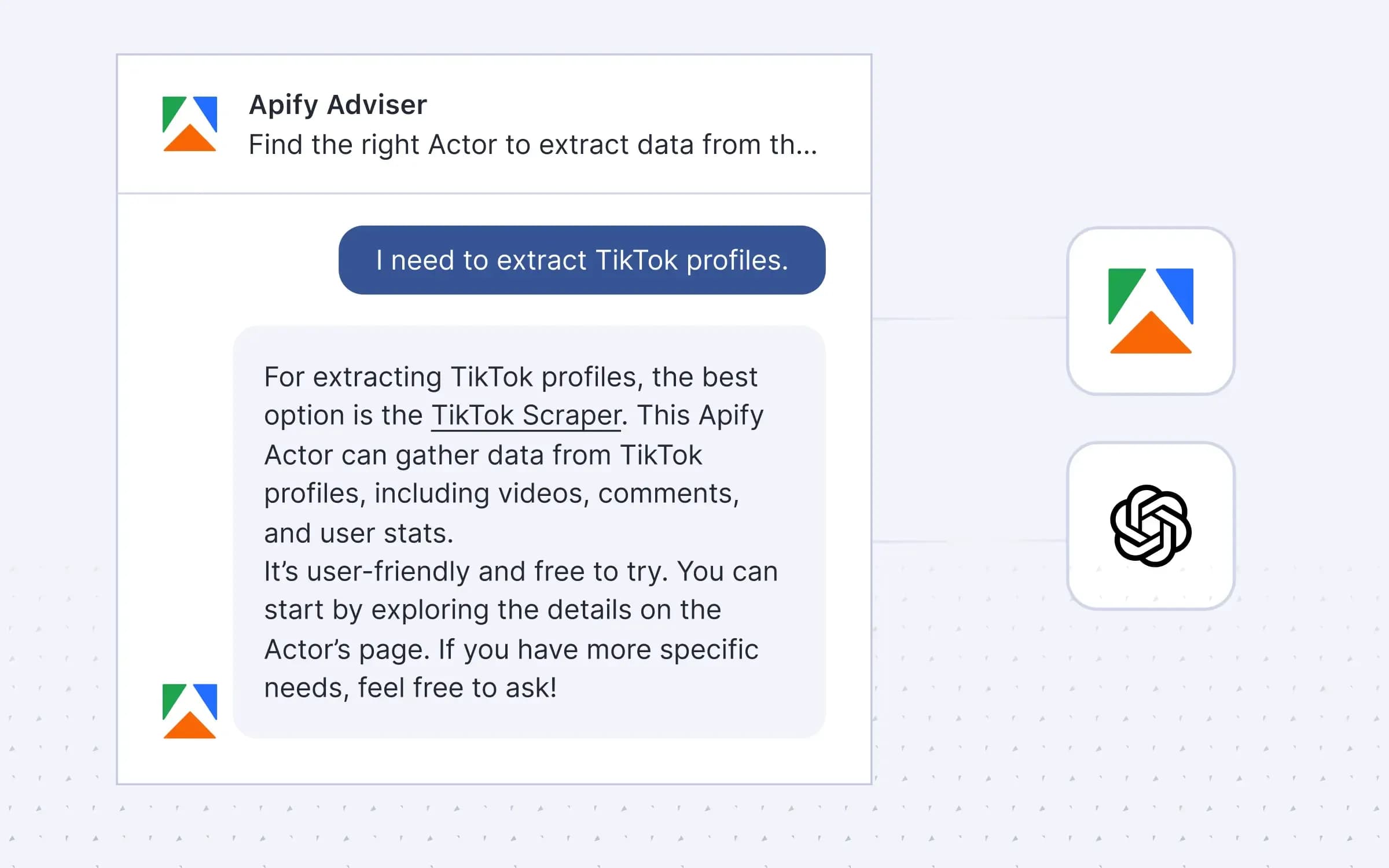
Apify Adviser GPT
Find the right Actor to extract data from the web or get help with the Apify platform. Our Adviser GPT has been trained to assist you with any questions you might have about using Apify or Actors.

Generative AI is a type of deep learning model focused on generating text, images, audio, video, code, and other data types in response to text prompts. Examples of generative AI models are ChatGPT, MidJourney, and BARD.
AI is a field of computer science that aims to create intelligent machines or systems that can perform tasks that typically require human intelligence. Generative AI is a subfield of AI focused on creating systems capable of generating new content, such as images, text, music, or video.
Large language models, or LLMs, are a form of generative AI. They are typically transformer models that use deep learning methods to understand and generate text in a human-like fashion. Examples of LLMs are ChatGPT, LLaMA, LLaMDA, and BARD.
Data ingestion is the process of collecting, processing, and preparing data for analysis or machine learning. In the context of LLMs, data ingestion involves collecting text data (web scraping), preprocessing it (cleaning, normalization, tokenization), and preparing it for training (feature engineering).
Most of the information agents need lives on the web, but agents can't access it on their own. Apify Actors bridge that gap, fetching structured data from any website in real time. The same approach works for RAG pipelines, chatbot grounding, and model fine-tuning wherever live web content makes the difference.
Vector databases are designed to handle the unique structure of vector embeddings, which are dense vectors of numbers that represent text. They are used in machine learning to index vectors for easy search and retrieval by comparing values and finding those that are most similar to one another.
LangChain is an open-source framework for developing applications powered by language models. It connects to the AI models you want to use and links them with outside sources. That means you can chain commands together so the AI model can know what it needs to do to produce the answers or perform the tasks you require.
Pinecone is a popular vector database that lets you provide long-term memory for high-performance AI applications. It is used for semantic search, similarity search for images and audio, recommendation systems, record matching, anomaly detection, and natural language processing.
- Data collection: use a tool like Apify's Website Content Crawler to scrape web data. Configure the crawler settings like start URLs, crawler type, HTML processing, and data cleaning to tailor the data to what you need.
- Data processing: clean and process the scraped data by removing unnecessary HTML elements, duplications, and transforming it into a usable format (e.g. JSON, CSV).
- Integration and training: integrate the cleaned and processed data with tools like LangChain or Pinecone and feed it into your LLM to fine-tune or train the model according to your specific requirements. Check out this full step-by-step tutorial on how to collect data for LLMs with web scraping.
RAG is an AI framework and technique used in natural language processing that combines elements of both retrieval-based and generation-based approaches to enhance the quality and relevance of generated text. It is used as a way to improve generative AI systems.
RAG is a popular method for creating chatbots because it combines retrieval-based and generative-based models. Retrieval-based models search a database for the most relevant answer. Generative models create answers on the fly. The combination of these two capabilities makes RAG chatbots adaptable and mitigates hallucinations.